Rounding the bend from
Israel and Gifts from the World is Chile.
The giant stone Moai of Peace stands at
the entrance and represents the hundreds
of similar monuments on Easter Island
(which became a part of Chile in 1888).
These statues are the remnants of a
mysterious ancient culture. According to
the Epcot 2000 Commemorative Program,
this particular statue was created in
1991 for the Easter Island Non-Profit
Association. It was flown to Epcot from
Chile. Further information about these
statues (including pictures of its
installation at Epcot) can be found at www.easterislandmoai.com.
Clouds line the top of
the back wall of the display with the
Chile sign in the middle and grapes
underneath. The Chile exhibit also
features two interactive game terminals
and a display about the Chilean
fogcatching invention which catches fog
and turns it into drinking water. Above a
rotating Chile sign are clouds that emit
fog. The fogcatcher is an Expo 2000
Project from Around the World.
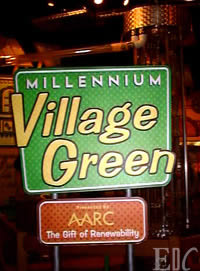 Across from
Chile, Millennium Village Green allows
children the opportunity to learn about
renewability - making products out of
things that can be grown and then when
finished with the product returning it to
the earth for new products. Guests pick
up red, green, and yellow plastic balls
and put them into slots on a storefront.
Then through a series of motions, mazes,
and tasks, the balls are moved from
storefront to storefront until they reach
the yard where they are tossed into holes
in tires and windows sitting in what is
like a giant compost pile to start the
process over again. A tally is kept to
identify the number of resources (balls)
that have been renewed that day. The
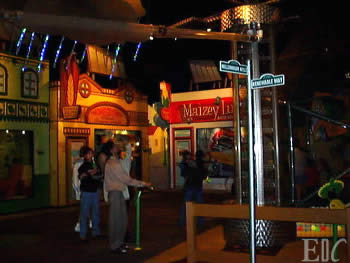
Maizey Lube storefront uses a stationary
bicycle's power to convey the balls
through it. It also shows how oil made
from corn can be used for cars. Another
storefront is about renewable lumber for
furniture. A road sign at the entrance
identifies the red ribbon road as
Millennium Aisle while the Village Green
is on Renewable Way.
Across from
Chile, Millennium Village Green allows
children the opportunity to learn about
renewability - making products out of
things that can be grown and then when
finished with the product returning it to
the earth for new products. Guests pick
up red, green, and yellow plastic balls
and put them into slots on a storefront.
Then through a series of motions, mazes,
and tasks, the balls are moved from
storefront to storefront until they reach
the yard where they are tossed into holes
in tires and windows sitting in what is
like a giant compost pile to start the
process over again. A tally is kept to
identify the number of resources (balls)
that have been renewed that day. The
Maizey Lube storefront uses a stationary
bicycle's power to convey the balls
through it. It also shows how oil made
from corn can be used for cars. Another
storefront is about renewable lumber for
furniture. A road sign at the entrance
identifies the red ribbon road as
Millennium Aisle while the Village Green
is on Renewable Way.
World Marketplace
features artisans and products from eight
more countries. It is entered by passing
through a red yurt. What's a yurt? Well,
according to the sign outside the yurt,
it is a tent-like wooden structure
invented by Turkish and Mongolian nomads
more than 2500 years ago. It is usually
covered by a woolen fabric to keep the
inhabitants warm but was kept open here
to allow easy viewing of the structure
and the crafts inside. Normally the two
large archways cut into its sides would
not be there either. The real doors to
the yurt are located on the backside and
are much smaller. The yurt was provided
by the Kyrgrz
(pronounced ker-geez) Republic
in central Asia.
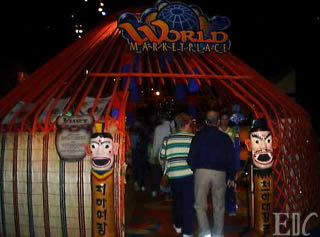 Inside the yurt are masks,
dolls, and boxes from Korea.
Leaving the yurt, on the left is Peru.
Small pieces of pottery and miniature
instruments are some of the many items
found here. An example of an instrument
is a wooden insect that when blown into
makes different tones depending on which
holes your fingers are covering.
Inside the yurt are masks,
dolls, and boxes from Korea.
Leaving the yurt, on the left is Peru.
Small pieces of pottery and miniature
instruments are some of the many items
found here. An example of an instrument
is a wooden insect that when blown into
makes different tones depending on which
holes your fingers are covering.
To the right is Venezuela
featuring hand painted clay and
hand-woven blankets. We might even see an
artisan using the real loom. Further
along the path and next to Venezuela is Egypt.
This display carries Egyptian jewelry,
glass perfume containers, drums, and gold
covered plates. Illustrations on papyrus
paper are also available.
Across from Egypt is Greece.
Sometimes guests can see pots being
created on the potting wheel. Grecian
urns and plates, miniature columns, and
statues are some of the items found here.
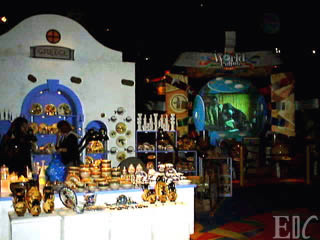
Next to Greece is the World
Culture Game presented by The
World Bank. Guests can compete to answer
questions about the gifts cultures have
brought to the world. Every hour, The
World Bank presents a video at this
location. Tucked away behind Greece and
to the far left of the World Culture Game
is a large mural with The World Bank logo
and this text: "Our dream is a world
free of poverty."
Across from the World
Culture Game is Thailand
which features elaborate paper origami
dragons and insects, jewelry, wooden
noise makers, and chopsticks. Lebanon
sits next to Thailand. One can browse
through blankets, jewelry, dolls, chess
boards and pawns, and mosaics. Nestled
between these two countries is where the
public phones and restrooms are located.
These cavernous restrooms, which can also
be accessed from the outside of the
pavilion, must be the largest restrooms
on Disney property.
Across from Lebanon is
the cash registers. When buying a craft
from an artisan, the cast member fills
out a form which the guest then takes to
the register, pays for the item, and then
returns with the form to the artisan. By
then, the item is wrapped and ready for
the guest to take home.
Continue on the
path or choose an exhibit from the
list below: